

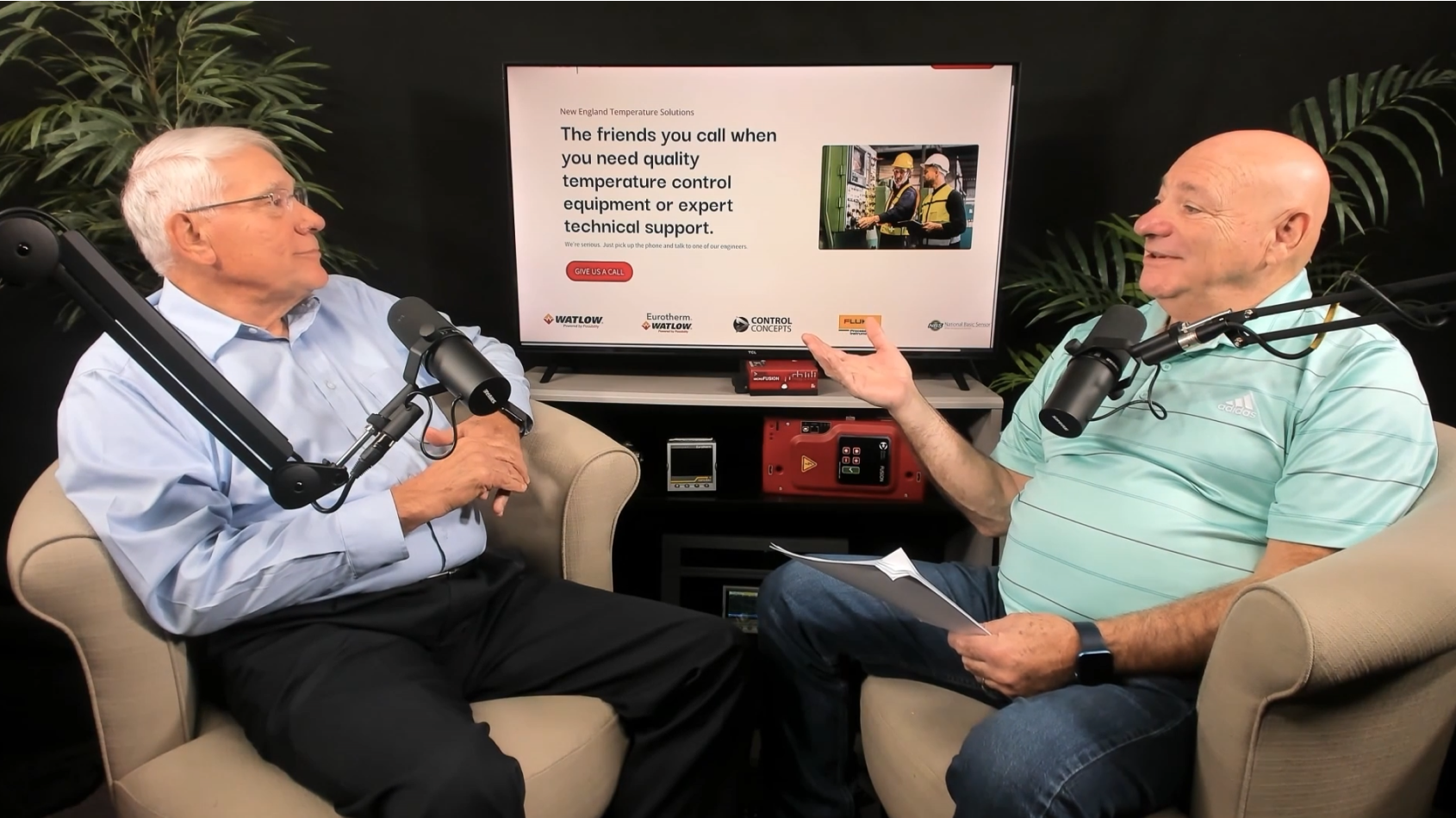
In this podcast with Control Concepts’ Director of Sales Dan Bender, learn about harmonics and their effects. Most importantly, learn why a comprehensive power study is invaluable: finding hidden harmonics before they cause problems.
Transcript Summary
Dominick DeLuca:
Hi, and welcome to the podcast! I’m Dominick DeLuca, President of New England Temperature Solutions (NETS). Today, we have a special guest, Dan Bender from Control Concepts. Dan, thanks for joining us!
Dan Bender:
Thanks, Dominick. Glad to be here!
Dominick:
Before we jump into today’s topic, tell us a little about yourself.
Dan:
Sure! I’m Dan Bender, Director of Sales at Control Concepts, and I’ve been with the company for 15 years. I’ve been in the industrial controls and power quality industry for 46 years and have seen a lot of changes along the way. On a personal note, I’ve been married 51 years, have six children, and ten (soon to be eleven) grandchildren.
Dominick:
That’s amazing—congratulations! And we’ve known each other for a long time. We first crossed paths in the 1980s when you were with Robocon, which eventually became part of Eurotherm, then Siemens. Fast forward to today, and you’re at Control Concepts, helping customers solve power quality issues, especially when it comes to harmonics—which is today’s topic!
What Are Harmonics?
Dominick:
Power quality is a huge issue in industrial settings. We’ve covered topics like power factor and peak demand in a previous episode, but today we’re focusing on harmonics. Can you break it down for us?
Dan:
Absolutely. Harmonics are essentially destructive electrical currents that flow through a system, causing overheating, inefficiencies, and even equipment failures.
Dominick:
And the problem with harmonics is that you can’t see them, right? You only notice them when things start going wrong.
Dan:
Exactly! You can’t visually detect harmonics, but their effects are very real. They can cause:
- Overheating of bus bars and transformers
- Capacitor failures in power factor correction systems
- Electrical noise that disrupts sensitive equipment
- Misfiring of SCRs (silicon-controlled rectifiers)
- Unexpected shutdowns
Why Are Harmonics More Important Now?
Dominick:
This topic is getting more attention lately. Is that because of the push for electrification in industry?
Dan:
Exactly! As industries shift from fossil fuels to electricity, the demand on the power grid is increasing. Many industrial processes rely on electric furnaces, motors, and other power-hungry equipment, and all these loads can introduce harmonic distortion into the system.
Dominick:
And if a company is introducing harmonics into the electrical grid, it doesn’t just affect their facility, it can impact their neighbors, too.
Dan:
That’s right. If you’re sending harmonic currents back onto the grid and your neighbor is a hospital running MRI machines, it can create real problems. That’s why utilities enforce power quality standards, like IEEE 519, to ensure companies aren’t disrupting the grid.
How Do You Detect Harmonics?
Dominick:
So, let’s say a company suspects they have a harmonics problem. What are the warning signs?
Dan:
Some common indicators include:
- Overheating transformers, bus bars, or neutral lines
- Frequent capacitor bank failures
- Voltage distortion or flickering lights
- Interference with sensitive electronics or networks
Dominick:
And how do you confirm it’s harmonics and not something else?
Dan:
That’s where a power quality study comes in. A reputable power quality company will install monitoring equipment at key points (especially at the Point of Common Coupling, or PCC) to measure harmonics over several days.
What Causes Harmonics?
Dominick:
What types of equipment are the biggest culprits for generating harmonics?
Dan:
Harmonics are caused by non-linear loads, devices that chop up the sine wave instead of using a smooth AC waveform. The biggest offenders include:
- SCR power controllers (like Phase Angle fired SCRs)
- Variable frequency drives (VFDs)
- UPS systems
- DC power supplies
- Electronic lighting dimmers
Dominick:
I remember as a kid, we had a dimmer switch in our house. Every time my mom turned it on, the AM radio signal would disappear. That was harmonics in action!
Dan:
Exactly! That’s a great example. Harmonics generate electrical noise that can interfere with communication systems and sensitive equipment.
How to Fix Harmonic Problems
Dominick:
So, let’s say a company knows they have a harmonics problem. What are the best solutions?
Dan:
There are a few ways to mitigate harmonics:
Passive Solutions:
- Install harmonic filters (to absorb unwanted frequencies)
- Use line reactors or chokes (to smooth out current waveforms)
- Switch to multi-pulse drives (like 18- or 24-pulse VFDs)
Active Solutions:
- Active harmonic filters dynamically cancel harmonic distortion in real-time.
- Better system design – sometimes, simply relocating equipment can reduce harmonic interference.
Strategic Filtering at the Right Level
- Instead of filtering every individual device, it’s often more cost-effective to apply filtering at the branch circuit or facility level.
Dominick:
And not every company needs to fix harmonics at the device level, right?
Dan:
Correct. A company might have some harmonic distortion, but if it isn’t causing overheating, failures, or violating IEEE 519, then it may not need immediate correction. That’s why a power quality study is so important: it tells you if you actually have a problem before you spend money on unnecessary solutions.
Final Thoughts
Dominick:
Dan, this has been a great discussion. Any final advice for companies concerned about power quality?
Dan:
My biggest advice is don’t guess—get a power quality study done by a reputable company. Harmonics can be expensive to fix, but spending money on the wrong solution is even worse.
Dominick:
Great advice. Thanks so much for being here, Dan!
Dan:
Thanks for having me!
Dominick:
And thanks to all our listeners! If you have questions about power quality, harmonics, or industrial control systems, reach out to us.