
Although modern industrial heating systems are expected to run reliably for years, system commissioning, heater failures, wiring issues, component degradation, and overcurrent events can cause expensive failures in the absence of protection devices like fuses and disconnects.
Fuses and disconnects are commonly installed together but serve different purposes. A fuse protects equipment by interrupting excessive current. A mechanical disconnect provides physical isolation from electrical power during maintenance, allowing you to meet local and national electrical codes. Both are necessary for safe and reliable industrial operation.
This guide explains how fuses and disconnects work, why they are critical for SCR-controlled systems, and how to select the right protection strategy for industrial applications.
What is a Fuse and Why is it Important?
A fuse is a sacrificial protection device designed to interrupt current flow when current exceeds a predetermined value, preventing equipment damage and electrical fires. Inside the fuse is a conductive element that melts when excessive current passes through it, meaning that power is removed from the circuit. Unlike circuit breakers, fuses need to be replaced after excessive current that has exceeded its fuse rating.
Semiconductor Fuses
Traditionally, semiconductor fuses are used to protect an SCR. When the average load current is close to the surge current rating of the SCR, you need a fusing device that will act fast enough to blow when the surge current has been exceeded. Semiconductor fusing meets these requirements. However, they have the tendency to fatigue fail, resulting in nuisance blows. Another drawback to semiconductor fuses is that they aren’t branch rated, requiring either secondary branch-rated fusing or a circuit breaker ahead of the device containing the semiconductor fuse.
Internal semiconductor fusing results in additional heat inside the controller.
A Better Solution: Class T Fuses
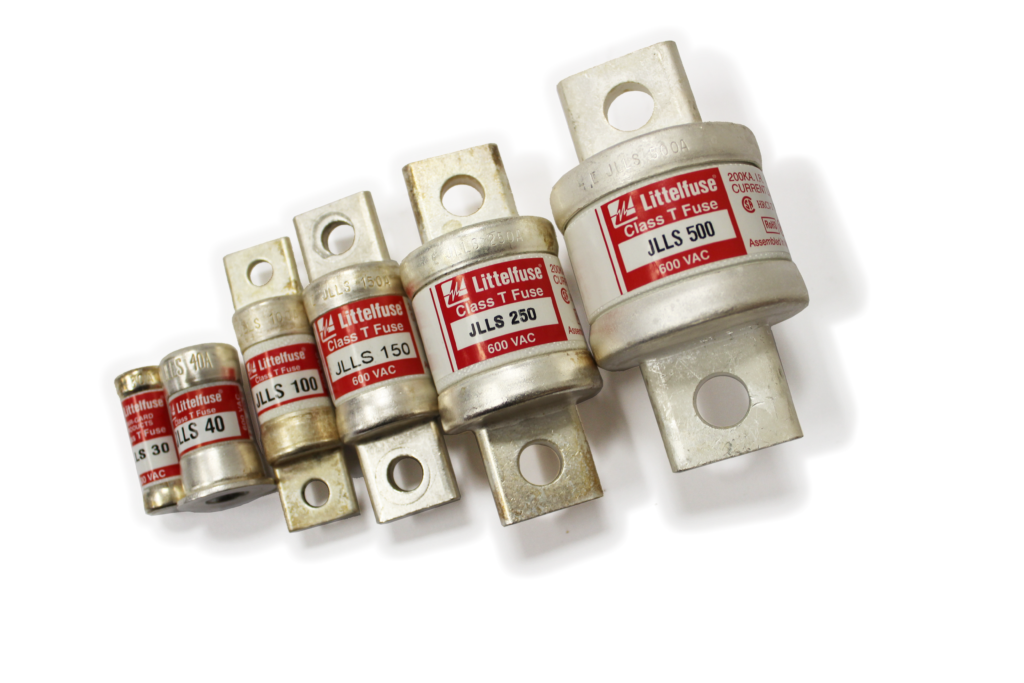
Control Concepts offers a different fast-acting fuse that balances reliability, cost, and protection: JLLS (600V) or JLLN (300V) Class T fuses by Littelfuse.
Control Concepts rates SCRs conservatively with extra high surge current levels. As a result, slightly slower Class T fuses can be used instead of semiconductor fuses.
Class T fuses are less expensive, more readily available, and are listed for branch service protection. Additionally, Class T fuses don’t nuisance blow like semiconductor fuses. Overall, using a single Class T fusing system enables cost reduction, decreased downtime, and lower maintenance costs.
Control Concepts controllers also offer an electronic Overcurrent Trip feature to prevent nuisance fuse blowing. It can be configured to operate shunt trip or under voltage trip circuit breakers to remove power in the event a load fault occurs. Contact us to learn more.
How to Size Fusing for an SCR Power Controller
Sizing fusing is simple: fuse size = controller full load amp rating * 1.25.
There are two important notes for this formula:
- Always Size Up: as a general rule, if your calculated fuse size falls within two sizes, round up to the nearest available fuse size.
- Optionally: if your full load amps is smaller than the rating of your controller, you can base the calculation on your actual load. For example, you may have an 80 Amp load connected to an 100 Amp controller. Typically, the fusing would be sized for 125 Amps, but with the smaller load, 100 Amp fusing would be reasonable. Wiring should still be sized appropriately according to the fusing.
Always check with local and national electrical codes to ensure your system meets regulations. Beyond matching amp ratings, proper fuse selection must consider voltage rating.
Load Protection Fusing
Any fuses provided within the controller are intended to protect the SCRs and may not be suitable for load protection.
What is a Disconnect and Why is it Important?
A disconnect switch allows for physical isolation of electrical equipment from its power source. Unlike a fuse, a disconnect is not primarily designed to interrupt fault current, but to increase workplace safety.
SCRs have a small leakage current in the off state. Therefore, it is imperative that a mechanical disconnect be used to completely remove power prior to servicing. In addition, disconnect switches enable compliance with local regulations and provide a visible verification that a circuit is safe to work on.
Selecting the Right Disconnect Switch
Several factors should be evaluated when selecting a disconnect. Voltage requirements must match system voltage and current capacity must support anticipated load currents. Additionally, the environmental rating of the disconnect must match the enclosure’s environment, indoor or outdoor. For maintenance safety, the disconnect should have lockout capability and visual indicators.
Lockout/Tagout (LOTO) and Disconnects
Disconnect switches enable critical Lockout/Tagout procedures. Prior to maintenance, the equipment gets disconnected via the disconnect switches, the disconnects are locked, warning tags are applied, and maintenance can proceed safely. These procedures save lives.
Control Concepts offers Lockout/Tagout features on custom controllers.
TouchSafe Fuse Kits
Control Concepts offers all-in-one TouchSafe fuse kits, which include the fuseblocks, fuses, and protective covers. These cost-efficient kits minimize the headache of coordinating the fusing for your system and provide excellent touch-safe protection.
Protection Is an Investment, Not an Expense
When evaluating system costs, it can be easy to focus only on equipment purchase price. However, protective devices like fuses and disconnects are an insurance policy against expensive SCR failures and production downtime. Most importantly, fuses and disconnects are investments in the safety of operators.
Whether you’re designing a new installation, upgrading existing equipment, or improving electrical safety, selecting the right protection components is essential. Contact us to learn how we can help implement your SCR power control solution with the protection, safety, and reliability features you need.